Japan received 42.7 million international visitors in 2025, a record. Most of them follow the same line from Tokyo to Kyoto, queue at the same shrines and try for the same handful of tables. Our 2026 guide to Japan was written for the traveler who wants something else: fewer places, each chosen for a reason, and the practical detail that makes them work on the day. Which day a market closes, which garden takes visitors by reservation only, which room has to be booked six months ahead.
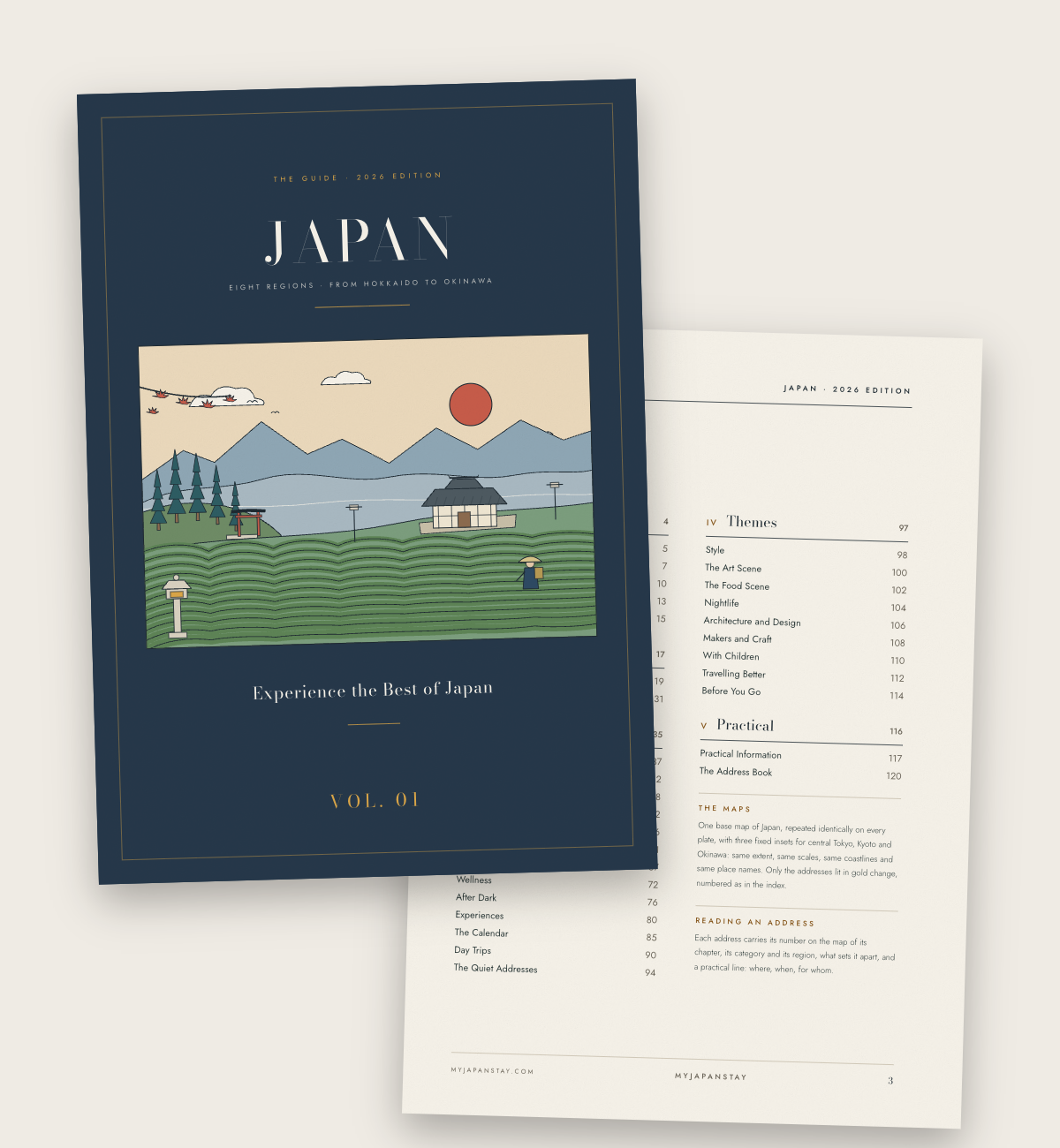
What is inside
122 plates. 102 numbered addresses, from a ryokan in Hakone on the grounds of a former summer residence of the Imperial Family to a tonkatsu house set in a converted public bathhouse near Omotesando. 22 maps. 30 illustrations. Three itineraries. Five parts: the opening, the territory, the address book, the themes and the practical chapters.
The address book is the heart of it: 10 places to stay, 12 restaurants, 8 bars, 6 addresses for coffee and early hours, 10 for shopping, 10 for culture and heritage, 8 outdoors, 5 for wellness, 6 after dark, 8 experiences, 8 dated events in the calendar, 6 day trips and 5 quiet addresses for the traveler who already knows the country.
Eight regions rather than one country
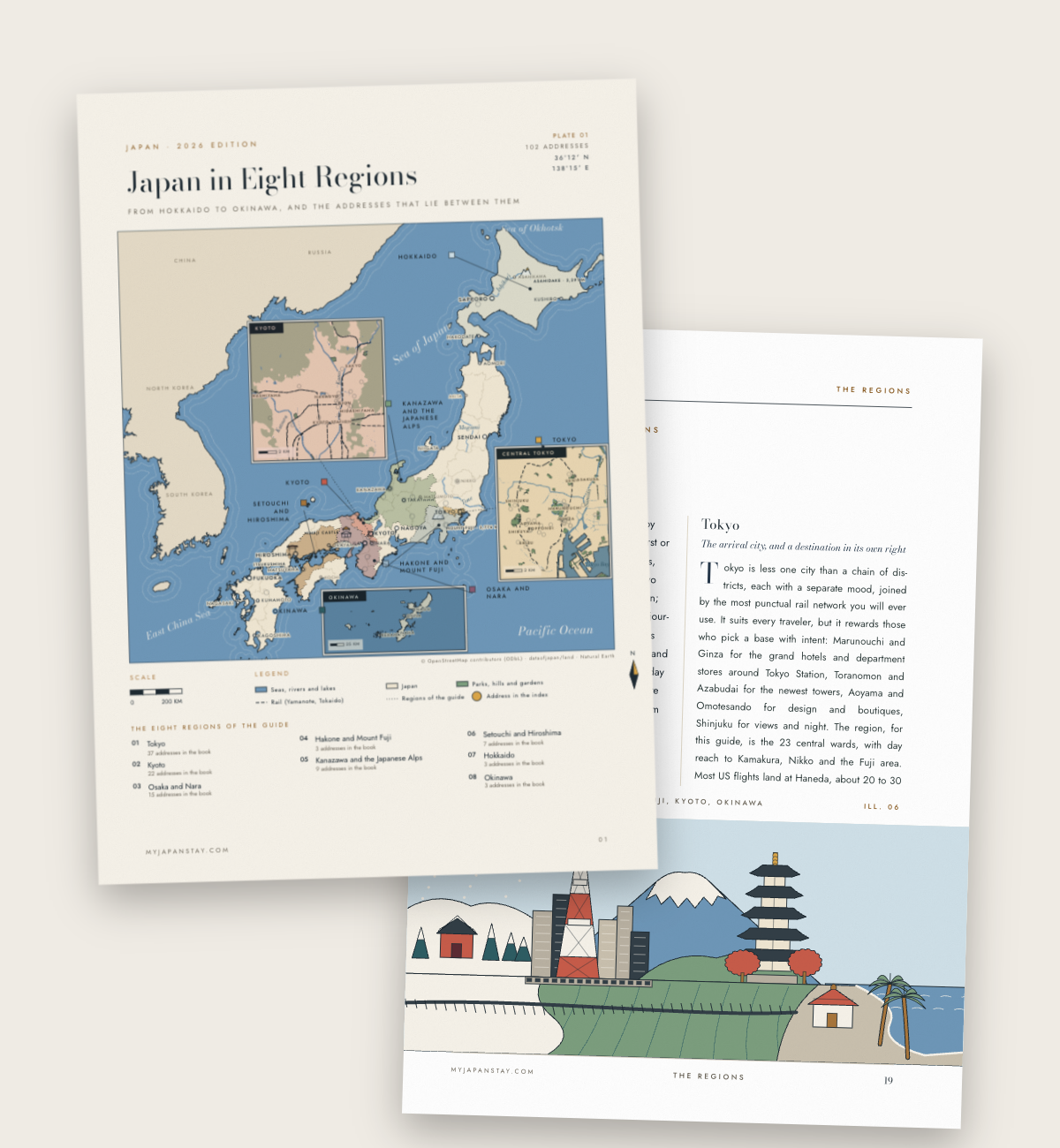
Japan is crossed by rail, not by car, so the guide divides it the way a first or second trip actually unfolds. Tokyo carries 37 addresses and Kyoto 22. Osaka and Nara follow with 15, Kanazawa and the Japanese Alps with 9, Setouchi and Hiroshima with 7. Hakone and Mount Fuji, Hokkaido and Okinawa have 3 each. For every region the guide says what it is like, whom it suits, where it starts and ends, and whether it deserves nights of its own or a day on the way somewhere else. Travel times are given from the main rail hubs, because from the moment you land, the train is how you move.
Twenty-two maps on a single base map
Every map in the guide is the same drawing of Japan, with three fixed insets for central Tokyo, Kyoto and Okinawa: same extent, same scales, same coastlines, same place names. Only the addresses lit in gold change from one plate to the next, numbered as in the index. Turn from Where to Stay to Where to Eat and you see at once which table sits near which hotel.
Every address says why it is here
Each entry carries its number, its category, its region, a detail that sets it apart and a line that says why it is in the book, then a practical block: where, when, for whom.
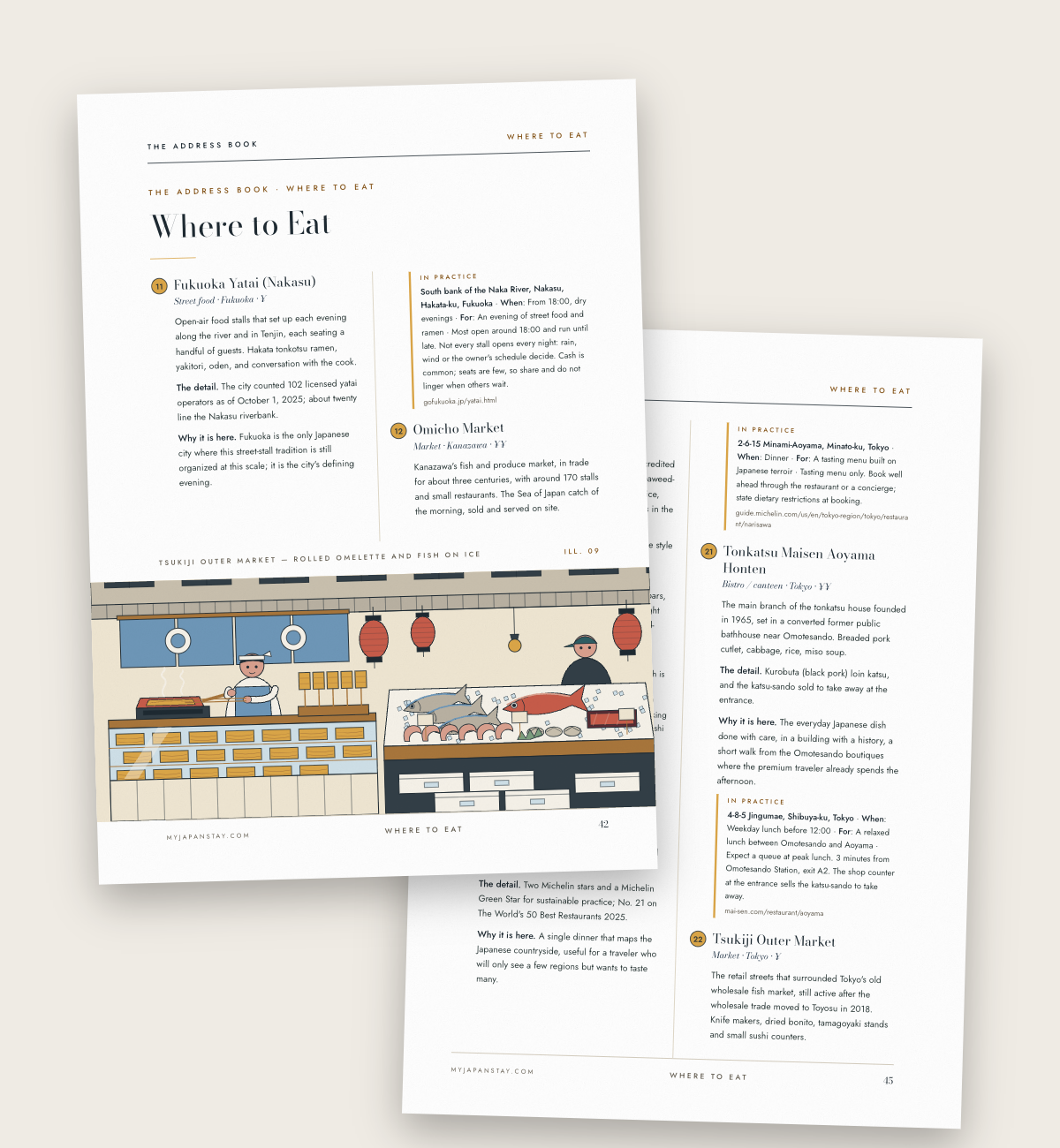
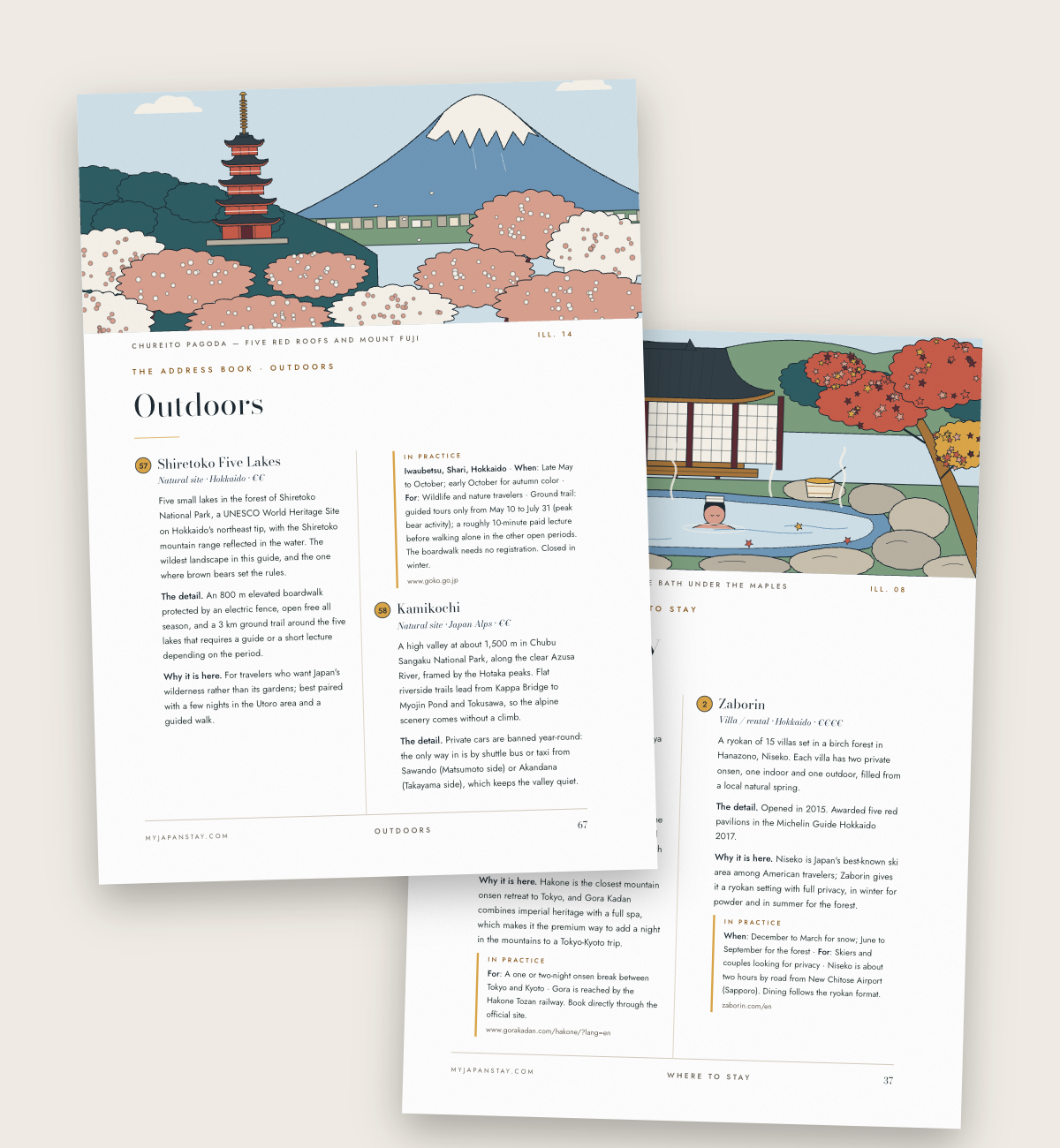
Ginza Kyubey, the sushi house open since 1935, is there because it serves serious Edomae sushi at a counter a visitor can actually book, and the guide tells you lunch is the easier seating. Zaborin, fifteen villas in a birch forest in Niseko, is there because it gives Japan's best-known ski area among American travelers a ryokan setting with full privacy, in winter for powder and in summer for the forest. Saihoji, the Moss Temple in western Kyoto, has taken visitors by reservation only since 1977, and you copy the Heart Sutra with brush and ink before you are allowed into the garden.
Three itineraries, built only from the book
Three days in Tokyo, from one base with no transfers, run from Tuesday to Saturday because Tsukiji Outer Market closes on Sundays and the Nezu Museum on Mondays. A week from Tokyo to Kyoto, by way of Hakone and Nara. Fourteen days west to the Inland Sea, through Kanazawa, Kyoto, Osaka and Himeji to the art islands of Naoshima and Teshima, then Miyajima and Hiroshima. Each one names the days of the week it avoids and what has to be booked before you fly, because in Japan the best rooms, tables and gardens are gone months ahead.
Nine themes, and a drawn guide
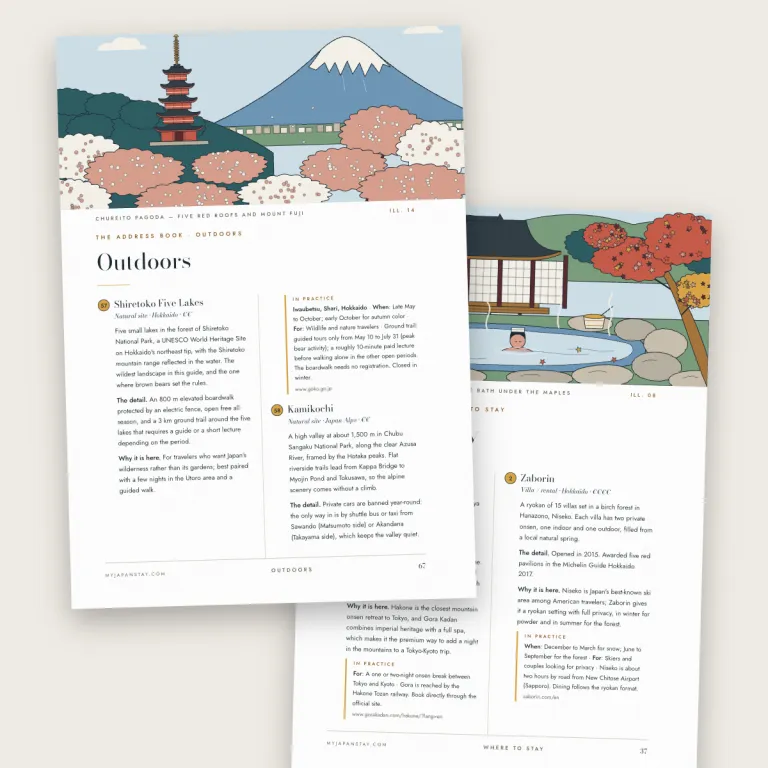
After the addresses come nine themed chapters: style, the art scene, the food scene, nightlife, architecture and design, makers and craft, Japan with children, traveling better, and the books and films to take in before leaving. The guide is drawn rather than photographed: 30 illustrations run through it, from a stall at Tsukiji Outer Market to the Chureito Pagoda under Mount Fuji.
Written for a reader leaving from the United States
The guide is written in English for a traveler flying from the US, and its practical chapter was checked in September 2026. US citizens still enter Japan without a visa for tourist stays of up to 90 days, and Visit Japan Web replaces the paper forms on arrival. Several rules change between 2026 and 2028: the departure tax rose from 1,000 to 3,000 yen on July 1, 2026, Kyoto raised its accommodation tax on March 1, 2026, tax-free shopping becomes a refund after departure from November 1, 2026, and JESTA, an online travel authorization on the model of the US ESTA, is planned for 2028.
The guide is free. It opens in the browser, on a phone as well as a computer, and nothing needs to be installed.